
Two fence panels can look almost identical on day one. Five years later, one is still performing while the other is an eyesore—or worse, a safety hazard. Here’s how to make sure you’re buying the one that lasts.
You’re staring at two quotes for welded wire mesh fence panels. Both are steel. Both show up looking clean and professional on installation day. But one quote is 15-20% higher because of a PVC coating layer. Is it worth the extra money? Or is plain galvanized enough?
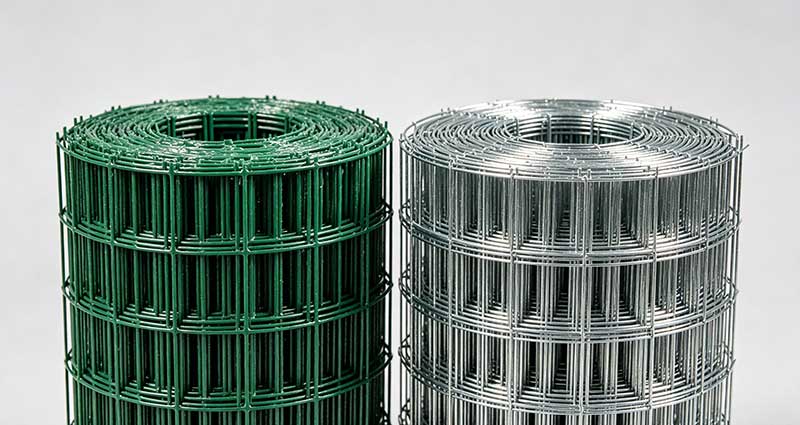
The honest answer: it depends entirely on where the fence is going and what it’s up against. Choose wrong, and you are either overspending on protection you do not need, or under-specifying a fence that will rust through in five years.
This article breaks down exactly how these two coatings work, where each one wins, and how to decide based on your actual site conditions—not a sales sheet.
How Each Coating Protects the Steel (They Work Differently)
Before comparing lifespan, it is essential to understand what is happening at the surface level. Both coatings prevent rust, but through fundamentally different mechanisms.
Hot-Dipped Galvanized Coating (HDG)
HDG steel is dipped in molten zinc. The zinc bonds metallurgically with the steel, forming layers of zinc-iron alloy that are harder than the base steel itself.
How it protects:
- Barrier protection: The zinc layer physically blocks moisture and oxygen from reaching the steel.
- Sacrificial protection: If the coating is scratched, the surrounding zinc corrodes instead of the steel. This is the critical advantage—galvanized fences “heal” small scratches.
Common spec for fencing: Minimum 40-60 g/m² zinc weight for outdoor use. Heavy-duty applications specify 80 g/m² or higher.
PVC Coating (Powder or Plastisol)
PVC coating is applied over a base layer—typically galvanized steel or bare steel. The steel core is first galvanized (for quality products), then a layer of PVC powder or plastisol is fused onto the surface through heat.
How it protects:
- Barrier-only protection: The thick plastic skin seals out moisture, oxygen, and chemicals. It adds a thick, resilient layer.
- No sacrificial protection: If the PVC layer is punctured, moisture can creep under the coating, rusting the steel from the inside while the outer plastic looks intact. This is called under-film corrosion.
This distinction is the foundation of every durability comparison that follows.
Head-to-Head Durability Comparison
| Factor | Hot-Dipped Galvanized (HDG) | PVC Coated (over Galvanized) |
|---|---|---|
| Standard lifespan (mild environment) | 20-30+ years | 15-25 years |
| Scratch resistance | Excellent – zinc self-heals small scratches | Poor – scratches expose steel, under-film rust spreads |
| UV / sunlight resistance | Impervious to UV | PVC degrades over time (chalking, fading, embrittlement), typically 10-15 years before visible degradation |
| Chemical / coastal resistance | Moderate – zinc eventually corrodes in salt spray or acid rain | Excellent – PVC is nearly inert to most chemicals and salt |
| Aesthetics over time | Develops a uniform matte gray patina | Fades and chalks gradually; green and black are standard |
| Color options | Metallic silver only | Green, black, and custom colors available |
| Cost comparison | Base price | Typically 15-30% more per panel |
Key takeaway: HDG lasts longer in most inland environments. PVC adds a useful barrier against chemical or coastal corrosion but is more vulnerable to physical damage and UV aging.
Where Each Coating Wins: Real-World Scenarios
Choose Galvanized when:
- Your site is inland, away from saltwater or heavy industrial chemical exposure.
- The fence may experience physical impact, abrasion, or frequent handling.
- You want the lowest lifetime cost and maximum scratch tolerance.
- Aesthetics are secondary—you are fine with a uniform silver-gray finish.
Real-world examples: Highway guardrails, construction site temporary fencing, agricultural livestock pens, warehouse perimeter security.
Choose PVC Coated when:
- The fence is near the coast (salt spray) or in an industrial zone with chemical exposure.
- Aesthetics matter—you need a green fence that blends into landscaping, or a black fence for high-end commercial properties.
- Physical damage risk is low, so the coating remains intact.
- You are willing to pay a premium for appearance and specific corrosion resistance.
Real-world examples: Residential garden fencing, parks and public spaces, coastal property boundaries, high-visibility commercial perimeters.
The Hidden Factor: What Is Under the PVC?
Not all PVC-coated fences are created equal. The longevity of a PVC-coated panel depends heavily on the base layer under the plastic.
| Base Layer | What Happens Over Time | Verdict |
|---|---|---|
| PVC over Galvanized Steel | The zinc layer provides secondary protection if PVC gets scratched. Lifespan remains close to expectations. | Good choice for most applications. |
| PVC over Bare Steel | A single scratch allows moisture direct access to unprotected steel. Rust spreads silently under the PVC film, visible only when the plastic blisters or peels off in sheets. | Significantly shorter lifespan—often 5-8 years before failure. Avoid for outdoor use. |
Can PVC-coated fence panels be repainted if they fade?
No—not effectively. Once PVC chalks and fades from UV exposure, surface paint does not bond reliably. The better approach is to manage expectations upfront: green PVC will fade to a lighter shade over 8-12 years. If color retention is critical, consider galvanized with periodic repainting (which does bond to zinc) or specify UV-stabilized PVC formulations.
Will a scratched galvanized fence rust through eventually?
Only if the zinc layer is completely consumed. A deep scratch in HDG initially shows red rust, which is the exposed steel. Over weeks, the surrounding zinc sacrificially corrodes to cover the scratch with a protective zinc patina. This self-healing stops as long as zinc remains in the surrounding area. In normal outdoor conditions, a standard 60 g/m² coating provides decades of sacrificial protection before the base steel is at risk.
Why do some PVC-coated fences rust from the inside out?
This is almost always under-film corrosion caused by PVC applied over bare steel. Moisture enters through a pinhole, scratch, or cut end, then spreads along the steel surface under the plastic. Because the PVC film traps moisture, corrosion accelerates in the trapped environment. This is why reputable manufacturers always galvanize first, then coat with PVC—and why you should always confirm the base treatment before ordering.
Is PVC-coated fencing more expensive to maintain?
Indirectly, yes. If a PVC-coated panel is scratched, there is no effective field repair that restores both appearance and corrosion protection. You cannot simply spray galvanizing on a PVC panel. Galvanized panels can be touched up with cold galvanizing spray, which provides reasonable ongoing sacrificial protection. For this reason, galvanized fences tend to have lower maintenance costs over their full lifecycle, especially in high-contact areas.
Which coating handles extreme heat or cold better?
Galvanized steel handles both extremes with no degradation. PVC becomes brittle in sustained sub-freezing temperatures and can crack under impact in extreme cold. In very high heat (above 60°C / 140°F surface temperature), PVC softens and can deform slightly. For desert or arctic environments, galvanized is the safer specification.