
When fencing a playground, safety is not negotiable. Standard chain-link fences snag clothing, rust quickly, and invite climbing. That is why double wire mesh panels are now the preferred choice for schools, public parks, and daycare centers in Europe.
In this guide, we will cover the unique safety features of double wire panels for playground use, how they meet EN safety standards, and practical installation tips. Plus, we answer the most common questions buyers ask before ordering.
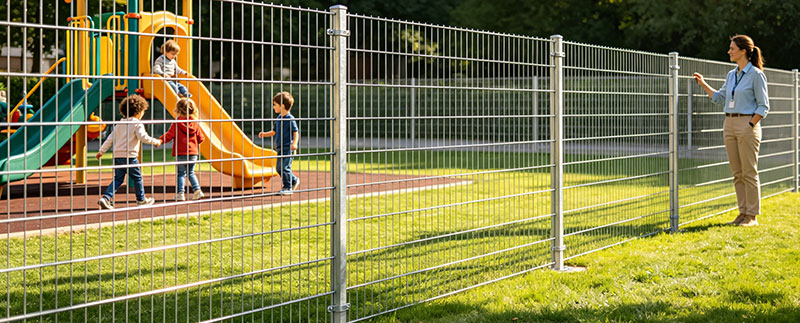
Why Choose Double Wire Mesh Panels for Playground Fencing?
A playground fence must do three specific things: keep children safe inside, prevent unauthorized access, and withstand daily physical impact. Here is how double wire mesh panels outperform standard fencing on each front:
1. No Finger Traps or Sharp Edges
The distinctive feature of a 656 double wire mesh panel is its grid density. The 200mm x 50mm mesh opening is small enough to prevent a child’s fingers, feet, or head from getting stuck. And because the panel is assembled with a flat, welded mesh surface and surrounded by folded edges, there are zero exposed sharp wire ends.
2. Anti-Climb Design for Child Safety
Children love to climb. Traditional diamond mesh acts like a ladder. The double horizontal wire structure of the 3D panel eliminates that grip. The V-shaped reinforcing bends make the panel rigid. A child cannot get a solid toehold on the smooth vertical wires, which significantly reduces climbing accidents—a key requirement that school safety inspectors check.
3. Shock-Absorbing Structure
In a busy playground, balls, running children, and even maintenance equipment will impact the fence. The double wire design, particularly the 8/6/8 configuration with a 6mm vertical wire, is tested to absorb impact energy without the panel buckling permanently. The V-bend acts as a spring, so the fence bounces back into shape when hit by a stray football.
Safety Standards for Playground Fencing: What to Specify
Before you install a double wire mesh panel for a playground, ensure the materials comply with the following:
| Specification | Requirement for Playground | Why It Matters |
|---|---|---|
| Mesh Opening | Maximum 50mm x 200mm | Prevents head, neck, and finger entrapment |
| Wire Diameter | Minimum 5mm vertical, 6mm horizontal | Resists bending from children leaning on it |
| Coating System | Galvanized + UV-stable powder coating | Non-toxic if touched, no rust flakes that can cut skin |
| Panel Height | Minimum 1.0m for toddlers; 1.5m-2.0m for older children | Prevents climbing over from standing height |
| Post Caps & Clamps | Rounded edges, nylon or plastic caps | Eliminates risk of cuts from sharp corners |
Installation Tips for a Safer Playground Fence
1. Correct Post Spacing
We recommend setting square posts at a maximum 2.5m spacing. This ensures the panel absorbs impact across its full length. For high-wind areas or sloping ground, reduce the spacing to 2.0m and use a thicker post wall (2.0mm instead of 1.5mm).
2. Ground Clearance Matters
Leave a 50mm gap between the bottom of the panel and the ground. This prevents the mesh from sitting in wet soil or grass clippings, which accelerates rust at the cut ends. It also makes sweeping and groundskeeping easier.
3. Use Tamper-Proof Clamps
Children can curiously unscrew standard bolts. We supply tamper-resistant clamp systems that require a special tool to remove. This ensures the fence remains securely joined and no loose components become a choking hazard.
What is the difference between the 868 and 656 double wire mesh panels for playgrounds?
The 868 panel uses 8mm horizontal wires and 6mm vertical wires, making it heavier and stronger. It is typically used for security or perimeter fencing. The 656 panel (6mm horizontal, 5mm vertical) is lighter, more cost-effective, and still very strong. For most school playgrounds, 656 provides more than enough rigidity while being easier to panel and install at height.
Can parents easily see through the fence to supervise their children?
Yes. The 200mm x 50mm mesh opening provides excellent transparency. Parents and staff can clearly observe the playground from outside. This is a major advantage over solid privacy fences, which create hidden blind spots where children can be out of view.
How long will a powder coated double wire mesh panel last in a playground exposed to sun and rain?
With a hot-dip galvanized base layer (minimum 60 g/m² zinc) and a UV-stable polyester powder topcoat, the panel will not structurally rust for 15-20 years. The color may gradually fade slightly over 10 years, but this is purely cosmetic. We recommend selecting RAL 6005 Green or RAL 5014 Blue for playgrounds.
Is it mandatory to have the panels CE marked for playground installation in the EU?
Yes. Playground fences installed with a permanent foundation fall under the Construction Products Regulation (CPR) . The panel must carry the CE mark, and the manufacturer must provide a Declaration of Performance (DoP) . We supply both documents standard with any order destined for a European school or park project.
What post system stops the panels from twisting if children swing on them?
We supply square posts 60x40mm with a base plate that can be bolted directly onto a concrete plinth. For swing-prone areas, we recommend a double-entry clamp that connects two panels to the same post. This creates a continuous rigid line that distributes the force. A single child swinging on a correctly installed double clamp cannot twist the fence out of alignment.