
Introduction: Why Your Horse’s Safety Depends on the Right Fence
Fencing is one of the most critical infrastructure investments for any horse farm or ranch. A poorly chosen fence can result in devastating veterinary emergencies—leg lacerations from sharp wire ends, torn tendons from hoof entrapment, or panic-induced injuries from poor visibility. For equine professionals and private owners alike, the fence must perform three essential functions: contain without injury, withstand equine pressure, and enhance property value.
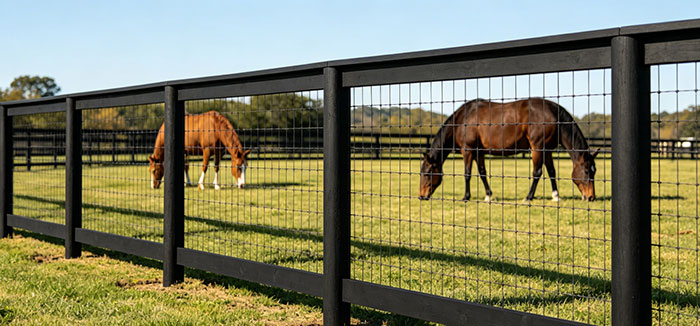
This guide explores why Premium Black Field Fence with a No-Climb Safety Design and Smooth Top & Bottom has become the preferred choice for discerning horse owners. We will examine the engineering behind the mesh, the advantages of the black finish, and how selecting the correct gauge ensures decades of reliable service.
Part 1: Understanding the “No-Climb” Safety Mesh Pattern
Traditional field fencing uses large, uniform openings that pose a significant hazard to horses. A curious or grazing horse can easily slide a hoof through a 6-inch opening. When the horse startles and attempts to flee, the leg becomes trapped, often resulting in a fractured cannon bone or severed extensor tendon.
The graduated mesh design solves this problem through geometry:
- Bottom Section (2″ x 4″ Spacing): This tight vertical spacing prevents hooves from passing through. It also serves as a critical barrier for foals, preventing them from rolling underneath the fence line into adjacent pastures or roadways.
- Upper Section (Graduated to 4″ x 4″ or 6″ x 6″): This allows for material efficiency while maintaining a barrier against leaning or climbing. Unlike standard hinge joint knot fences that can separate under pressure, the continuous weave design distributes force across multiple horizontal wires.
The Critical Feature: Smooth Top and Bottom Edges
Many economy fences feature a sharp, exposed “selvage” edge at the top wire. When a horse leans over the fence to reach greener grass on the other side, this edge scrapes against the chest and neck, removing hair and causing painful abrasions. A true premium black field fence eliminates this hazard by wrapping the top and bottom horizontal wires into the vertical stays, creating a completely rounded, smooth surface. Your horse can lean, scratch, or graze over the top without any risk of laceration.
Part 2: The Functional and Aesthetic Advantage of the Black Finish
While the internal steel core provides tensile strength, the black exterior coating—whether high-adhesion powder coat or heavy zinc-aluminum with a black polymer layer—provides distinct operational advantages over bare galvanized or green fencing.
- Enhanced Equine Visibility: Horses possess dichromatic vision. Against the backdrop of green grass, brown earth, or white snow, a black field fence creates a high-contrast silhouette. This visibility is crucial during low-light conditions at dawn and dusk when horses are most active and accidents are most frequent. Silver galvanized wire often “disappears” optically, leading to impact injuries.
- Rust and Corrosion Resistance: A premium black coating encapsulates the steel core, shielding it from moisture, urine-soaked soil, and corrosive fertilizers. In coastal ranch environments or high-humidity regions, black PVC-coated field fence significantly outlasts traditional galvanized wire.
- Professional Curb Appeal: Black fencing has become the visual standard for high-end equestrian estates. It frames the property elegantly, allowing the landscape and the animals to stand out visually. This aesthetic choice is proven to increase agricultural real estate valuation and buyer interest.
Part 3: Selecting the Correct Specifications for Long-Term Performance
To ensure your fence investment provides a 20+ year service life, attention must be paid to the wire gauge and the roll height. Below are the industry-standard specifications for a premium heavy-duty black field fence.
| Feature | Recommended Specification | Why It Matters for Horses |
|---|---|---|
| Wire Gauge | Class 1 Galvanized Core, 10.5 to 12.5 Gauge | Thicker wire resists bending when a horse leans its full weight (1,000+ lbs) against the fence. |
| Top/Bottom Wire | 9 Gauge | These high-tension wires prevent sagging between posts and maintain a straight, taut sightline. |
| Mesh Type | Fixed Knot or Tight Hinge Joint | Prevents vertical wires from sliding, which is essential for maintaining the 2″ x 4″ no-climb spacing. |
| Roll Height | 48″ to 60″ (4ft to 5ft) | 48″ is standard for paddocks; 60″ is recommended for active jumpers or stallions. |
| Coating | Black Zinc-Aluminum + Powder Coating | Superior adhesion prevents peeling and ensures the black color remains rich for decades. |
Part 4: Installation Best Practices for Maximum Safety
Even the highest quality fence will fail if installed incorrectly. For equine applications, the following practices are non-negotiable:
- Post Spacing: Set wooden posts every 8 feet on level ground. For corners and gate entries, use 8-inch diameter pressure-treated posts set in concrete footings to handle the massive tension load.
- Tensioning the Wire: Use a wire stretcher (come-along) to pull the fence to approximately 200-300 lbs of tension. A “hand-tight” fence is a dangerous fence; horses will test it and find slack.
- Stapling Technique: When attaching the fence to wooden posts, use 1.75″ to 2″ barbed galvanized staples. Crucial Step: Do not drive the staple fully home against the horizontal wire. Allow the wire to “float” slightly within the staple. This allows the fence to expand and contract with temperature changes without buckling or breaking the vertical stays.
Is this type of fence truly safe for foals?
Yes. The 2″ x 4″ graduated mesh at the bottom of the roll is specifically designed to prevent foals from rolling under the fence. However, for the first few weeks of life, it is always advisable to supervise foals or use a temporary inner “creep” fence to ensure they do not lie directly against the main perimeter fence.
How does the black coating hold up in extreme sun and cold?
Premium coatings utilize carbon black pigment in the polymer layer. Carbon black is a natural UV stabilizer, preventing the fading and chalking common with cheaper paint. In freezing temperatures, the coating remains flexible rather than becoming brittle and cracking.
Can I use this fence with electric wire?
Yes, and it is a highly recommended combination. Many horse owners install one strand of electric tape or wire on stand-off insulators placed 12 inches inside the top rail of the fence. This teaches horses to respect the boundary without touching the physical fence, extending the life of the mesh and preventing leaning damage.
What is the difference between a “No-Climb” fence and standard “Field Fence”?
Standard Field Fence: Often has uniform 6″ x 6″ openings and a knotted selvage top edge. Hooves can slip through the openings, and the top edge is sharp.
No-Climb Fence: Features graduated 2″ x 4″ spacing at the bottom and a smooth wire top and bottom. It is engineered to prevent hoof entry and abrasion injuries.
Do you offer bulk pricing for large ranches?
Yes. For projects requiring 50 rolls or more, container-load pricing and flexible shipping schedules are available. Custom specifications—including alternate heights, gauge changes, or specific coating thicknesses—can be accommodated for large-scale ranch developments.