
If you’re looking for wire mesh that won’t rust, won’t weaken over time, and can handle harsh conditions, stainless steel is the answer. But with different grades, weaves, and specifications available, choosing the right one can feel overwhelming.
This guide cuts through the confusion. Here’s what you actually need to know to buy the right stainless steel wire mesh for your project—without overpaying or making a costly mistake.
What Makes Stainless Steel Different?
Unlike galvanized steel (which relies on a zinc coating that can scratch or wear off), stainless steel’s corrosion resistance is built into the metal itself. The chromium in the alloy forms a protective layer that self-repairs if damaged.
That means:
- No rust from scratches
- No recoating needed
- Decades of service life
The 3 Grades You Need to Know
Not all stainless steel is the same. Grade selection is the most important decision you’ll make.
304 Stainless Steel – The Standard Choice
Best for: Most indoor and outdoor applications
Pros: Affordable, widely available, excellent general corrosion resistance
Cons: Can rust in saltwater or high-chloride environments
Use 304 for:
- Animal enclosures
- Garden fencing
- Food processing equipment
- General industrial use
- Architectural screens
316 Stainless Steel – The Marine Grade
Best for: Harsh environments
Pros: Contains molybdenum for superior corrosion resistance, especially against saltwater and chemicals
Cons: More expensive than 304
Use 316 for:
- Coastal installations
- Chemical plants
- Marine applications
- Poolside fencing
- Areas exposed to road salt
430 Stainless Steel – The Budget Option
Best for: Indoor, light-duty use
Pros: Lower cost
Cons: Less corrosion resistant, not suitable for outdoor use
Use 430 only for:
- Indoor shelving
- Decorative applications
- Temporary indoor projects
Quick Grade Selector
| Your Environment | Recommended Grade |
|---|---|
| Indoor, dry | 304 or 430 |
| Outdoor, normal | 304 |
| Coastal, saltwater | 316 |
| Chemical exposure | 316 |
| Food processing | 304 or 316 |
Woven vs. Welded: Which One Do You Need?
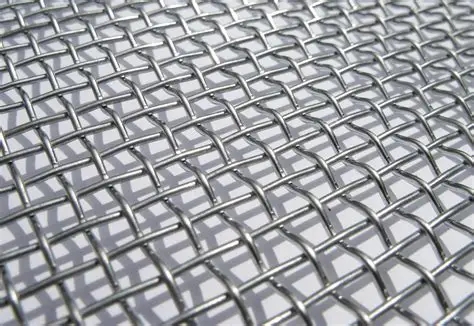
Woven Wire Mesh
Wires are woven over and under like fabric.
Best for:
- Filtration and sieving
- Insect screens
- Flexible applications
- Decorative panels
Pros: Flexible, available in very fine openings
Cons: Can unravel if cut
Welded Wire Mesh
Wires are welded at each intersection.
Best for:
- Security fencing
- Animal enclosures
- Concrete reinforcement
- Machine guards
- Rigid panels
Pros: Strong, won’t unravel, holds its shape
Cons: Less flexible, limited to larger openings
Which One?
| Project | Recommendation |
|---|---|
| Keeping animals in/out | Welded |
| Filtering liquids | Woven |
| Security fencing | Welded |
| Window screens | Woven |
| Concrete reinforcement | Welded |
Mesh Specifications: What the Numbers Mean
Mesh Count
The number of openings per linear inch.
- Low mesh count (1-20) : Large openings. Security fencing, animal enclosures.
- Medium mesh count (20-60) : Moderate openings. Garden screens, basic filtration.
- High mesh count (60-200+) : Fine openings. Industrial filtration, laboratory use.
Wire Gauge
Wire thickness. Lower gauge = thicker wire.
| Gauge | Thickness | Best For |
|---|---|---|
| 23-20 | Thin, flexible | Screens, light-duty |
| 19-16 | Medium | General purpose, animal cages |
| 14-12 | Thick, rigid | Security, heavy-duty |
| 10-8 | Very thick | Industrial, safety-critical |
Common Applications
| Industry | Use | Recommended Grade |
|---|---|---|
| Agriculture | Animal enclosures, fencing | 304 |
| Food processing | Conveyor belts, sifting screens | 304 or 316 |
| Marine | Boat screens, deck drains | 316 |
| Architecture | Facades, railings, partitions | 304 |
| Industrial | Filtration, machine guards | 304 or 316 |
| Security | Fencing, barriers | 304 |
5 Common Mistakes to Avoid
1. Assuming “Stainless” Means “Never Rusts”
Stainless steel is stain-resistant, not stain-proof. In saltwater or chemical environments, only 316 will hold up.
2. Using 304 in Coastal Areas
I’ve seen 304 rust within two years on beachfront properties. If you’re near saltwater, use 316.
3. Choosing Woven for Security Fencing
Woven mesh is flexible and can be cut more easily. For security, welded mesh is the stronger choice.
4. Buying by Price Alone
Cheap stainless often means lower-grade materials or poor manufacturing. Quality mesh lasts decades.
5. Ignoring Wire Gauge
Too thin and it won’t hold up. Too thick and it’s hard to work with. Match gauge to your actual needs.
How to Check Quality
Before buying, look for:
- Uniform openings: Consistent spacing across the sheet
- Smooth surface: No burrs or sharp edges
- Strong welds (for welded mesh) : Each intersection should be fully fused
- Even weave (for woven mesh) : No loose or pulled wires
Questions to ask your supplier:
- What grade is this? (304, 316, etc.)
- Is it woven or welded?
- What’s the mesh count and wire gauge?
- Can I see a sample?
Cost vs. Value
| Material | Initial Cost | Lifespan | Annual Cost |
|---|---|---|---|
| Galvanized | $ | 5-10 years | $$ |
| PVC-coated | $$ | 5-8 years | $$ |
| 304 Stainless | $$$ | 20-30 years | $ |
| 316 Stainless | $$$$ | 30-50 years | $ |
The bottom line: Stainless steel costs more upfront but often costs less per year over its lifetime.
Quick Selection Checklist
Before you buy, answer these questions:
- Where will it be used?
- Indoor → 304 or 430
- Outdoor → 304
- Coastal/chemical → 316
- Does it need to be rigid?
- Yes → Welded
- No → Woven
- What size openings?
- Security/animal → 1/2” to 2”
- Screening → Match to particle size
- Insect → 18-20 mesh
- How much strength needed?
- Light-duty → 20-23 gauge
- General → 16-19 gauge
- Heavy-duty → 8-14 gauge
Conclusion
Stainless steel wire mesh is a reliable, long-lasting solution when you choose the right grade and specification for your project.
My advice: For most outdoor projects, 304 stainless is the sweet spot—affordable and durable. If you’re near saltwater or chemicals, step up to 316. And always buy from a reputable supplier who can tell you exactly what grade you’re getting.
Take a few minutes to get the specifications right. Quality stainless steel mesh will serve you for decades.