
4 Galvanized Chain Link Fence: The Commercial Grade Specs That Actually Matter for Contractors
Let’s cut the tape, guys.
If you’re bidding on that city park job near the coast, or fencing off a temporary construction site next to an elementary school, you’ve probably got “4 galvanized chain link fence” scribbled somewhere on your takeoff sheet.
Here’s the thing I’ve learned in 20 years of buying steel for contractors across the Midwest and Gulf Coast: not all 4-foot fences are created equal.
I’ve watched GCs lose their shirt on warranty callbacks because they saved $40 a roll on mesh that rusted out before the concrete even cured. I’ve also seen sharp operators lowball a bid and still walk away with 30% margins—because they knew exactly what gauge to spec and where to source it.
Today, I’m giving you the real-world playbook. Not the manufacturer’s brochure fluff. The stuff that keeps your profit margin intact and your project manager off your back.
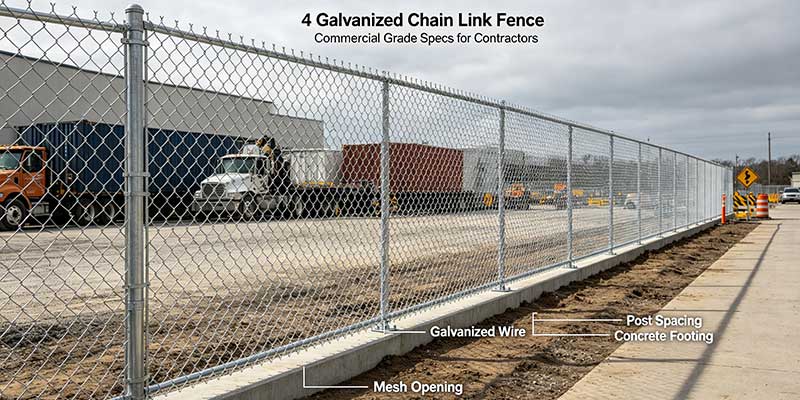
What does “4 feet” actually mean in commercial specs?
First things first: don’t assume 4 feet is just 4 feet.
In commercial construction, a 4-foot chain link fence (1.2 meters) is usually the sweet spot for three applications: crowd control barriers at events or transit hubs, equipment protection zones on active job sites, and perimeter backing for residential developments—keeping the public out of active utilities.
But here’s the kicker—and I can’t stress this enough: the height is almost irrelevant if the wire diameter is wrong.
I walk onto job sites all the time and see guys unrolling 4ft mesh from the big-box stores. That’s 11-gauge wire. Looks fine in the parking lot. But once you stretch it across 500 feet of uneven terrain and tension it? That lightweight mesh warps, the bar bends, and your nice straight fence line looks like a snake.
For commercial work, you need 9-gauge if you’re running a perimeter over 300 linear feet. It holds tension, it resists impact from construction debris, and it doesn’t sag when the frost line heaves in winter.
Hot-dipped versus electro-galvanized: the 10-year test
This is where I see more contractors get burned than anywhere else.
When you punch “4 galvanized chain link fence” into your search bar, you get two entirely different beasts wearing the same name.
First up is electro-galvanized. This is where the zinc gets applied electrically. The coating is thin—roughly 0.2 mils. It looks shiny and silver and pretty in the warehouse. But put this near a coastal area or a site with wet clay, and you’ll see red rust in 12 to 18 months.
Then you’ve got hot-dipped galvanized, which meets ASTM A653. This is the armor. The zinc is bonded through a molten bath. It’s heavier, it’s duller in color—more of a matte gray—but it meets the federal spec for durability. In a wet climate, you’re looking at 10 to 15 years before you even see surface oxidation.
Here’s the dirty little secret the cheap import guys don’t want you to know.
If the spec sheet doesn’t explicitly say “ASTM A653 G90” or higher, reject the quote. I don’t care how good the price is.
G90 means the zinc coating weighs 0.90 ounces per square foot. That is the minimum for a 5-year outdoor lifespan in most U.S. climates. If you’re within five miles of saltwater, you should be asking for G115 or a vinyl coating on top.
Pay the extra 15 to 20 percent upfront on the coating. It saves you 50 percent in labor replacement costs down the road. I’ve done the math on enough change orders to know that’s not a guess—it’s a guarantee.
What does OSHA actually say about 4-foot fencing?
Let’s get specific here, because this is where authority matters.
OSHA regulation 29 CFR 1926.502(b) covers fall protection systems. While it doesn’t mandate chain link specifically, it does require that any barrier used for fall protection or site security must withstand 200 pounds of force in any direction.
A 9-gauge, 4ft hot-dipped chain link fence with properly set posts—every 8 to 10 feet, set in concrete—easily exceeds that. An 11-gauge, cheaply staked version? I’ve seen those tip over when a worker leans on them.
Here’s my quick rule of thumb that I put on every bid sheet I review.
If the fence is purely for visual or traffic control, 11-gauge electro-galvanized is fine. But if the fence is for fall protection or security—meaning people are going to lean on it, kids might climb it, or heavy equipment operates nearby—then 9-gauge hot-dipped is the minimum. No exceptions.
How much does 4-foot galvanized chain link cost per foot in 2026?
Alright, let’s talk money—because I know that’s what actually matters when you’re sitting at your desk with a stack of bids.
As of July 2026, here’s the real-world pricing I’m seeing from mills and distributors across the U.S.
For 11-gauge electro-galvanized from import sources, you’re looking at 85 cents to $1.10 per linear foot for the fabric only. Cheap upfront, but plan on replacement in about two years.
For 11-gauge hot-dipped G90 from domestic mills, the price runs $1.25 to $1.50 per linear foot. This is the sweet spot for temporary commercial work.
For 9-gauge hot-dipped G90 from domestic mills, you’re at $1.60 to $2.00 per linear foot. This is the industry standard for permanent commercial installations.
And for 9-gauge hot-dipped G115, which is your coastal grade, you’re looking at $2.10 to $2.50 per linear foot. It’s premium, but worth every cent if you’re near saltwater.
Now, these numbers are based on Midwest mill sheet pricing and distributor quotes as of July 2026. Prices vary by region, order volume, and steel scrap markets—so always get three quotes before you commit.
But here’s the trap that catches a lot of guys.
That price is just the fabric. Your installed cost per foot is going to be three to four times that number once you factor in posts, top rail and tension wire, concrete and labor, and freight. Freight is the one that kills guys—steel is heavy, and shipping ain’t cheap.
Here’s a pro tip I give all my contractor clients. Always add a 10 percent escalator clause in your quote for any 4ft fence project that takes longer than 30 days to start. Steel prices move with scrap markets. If you lock in a price today and the job starts in two months, you could be eating an 8 to 10 percent increase straight out of your own pocket.
Best gauges for 4-foot temporary versus permanent fencing
Let me break this down the way I do with my own project teams.
For temporary construction barriers that are only going to be up for under 12 months, go with 11-gauge electro-galvanized. It’s lightweight, easy to relocate, and cheap to replace if a backhoe happens to hit it.
For permanent commercial perimeters—think schools, substations, parks—you want 9-gauge hot-dipped G90. It resists cutting, holds tension beautifully, and lasts 15-plus years.
And for coastal or high-corrosion zones, go with 9-gauge hot-dipped G115 or vinyl-coated. Salt air eats standard galvanizing in three to five years. Don’t skimp here.
Why does 9-gauge matter for security? A 9-gauge wire has a breaking strength of roughly 1,200 pounds, compared to about 800 pounds for 11-gauge. That doesn’t sound like much on paper, but in real-world terms, a pair of bolt cutters that snips 11-gauge like butter will struggle with 9-gauge. It’s a deterrent factor that matters if your site has expensive copper spools or heavy equipment parked overnight.
The hidden cost of imported mesh
I’m going to say something that might ruffle some feathers—but I’ve seen it too many times to stay quiet.
The cheap imported 4-foot galvanized fence that’s flooded the market? A lot of it uses a zinc-aluminum alloy coating instead of pure zinc.
Now, that sounds like a clever engineering upgrade, right? Aluminum is corrosion-resistant too.
Here’s the catch.
Aluminum reacts poorly with alkaline materials—like wet concrete. If your fence mesh touches freshly poured concrete, and on a construction site that’s almost inevitable, the aluminum in the coating will corrode at the contact point within 72 hours. I’ve walked job sites and seen rust blooms at every post where the mesh touched the concrete collar.
Domestic mills that follow ASTM standards don’t cut corners this way. Stick to materials that explicitly state “G90 hot-dipped galvanized per ASTM A653” on the mill certificate. If the supplier can’t provide a mill cert, walk away. Don’t look back.
4-foot versus 6-foot: which one should you actually spec?
This comes up in almost every pre-bid meeting I attend.
Four feet is best for equipment enclosures, rooftop HVAC screening, crowd control, and sightline preservation for security cameras. It’s the lowest material cost and the easiest to transport.
Six feet is for full perimeter security, prison yards, and high-risk sites. It costs 30 to 40 percent more in material and requires heavier posts.
If you’re fencing a detention pond, a transformer yard, or an HVAC unit on a rooftop, 4 feet is perfect. It keeps out the curious public but doesn’t block sightlines for security cameras mounted on nearby buildings.
If you’re fencing a school playground or a chemical storage yard, go 6 feet. Don’t even think about 4.
Your complete spec checklist for the next bid
Print this out. Stick it on your office wall. Use it on every quote.
First, make sure the coating is specified as hot-dipped galvanized, ASTM A653 G90 minimum.
Second, specify your wire gauge clearly: 9-gauge for permanent work, 11-gauge for temporary. And note it on the bid so there’s no confusion later.
Third, top rail diameter: use 1 and 5/8 inches OD for wind-prone areas, 1 and 3/8 inches for sheltered sites.
Fourth, post spacing: 8 feet for maximum tension, 10 feet for cost savings. Specify which one you’re bidding.
Fifth, post setting: minimum 24 inches deep in concrete, or to your local frost line—whichever is deeper.
Sixth, include a bottom tension wire for permanent installs. It keeps animals and debris from pushing under the fence.
And seventh, request the mill certificate before you pay. If they can’t provide it, don’t buy it.
Frequently asked questions from contractors
Can I use a 4-foot galvanized fence for a residential pool enclosure?
Generally, no. Most local building codes—which are based on the International Residential Code—require 5 feet minimum for pool barriers. Always check with your local Authority Having Jurisdiction before bidding a residential pool job.
How long will a 4-foot hot-dipped fence actually last?
In a dry inland climate, you’re looking at 20-plus years with minimal maintenance. In a wet, industrial, or coastal environment, you’ll get 7 to 10 years out of G90 before surface rust appears. That rust is usually cosmetic for the first few years—structurally, the fence remains sound for much longer.
What’s the difference between galvanized and vinyl-coated chain link?
Vinyl-coated is galvanized steel with a PVC outer jacket. It adds about 30 to 40 percent to material cost but provides extra corrosion resistance and color options like green, black, or brown. For 4-foot commercial work, I usually only recommend vinyl if the architect specifically calls for it or if aesthetics are a major concern.
Can I get 4-foot chain link with smaller mesh openings?
Absolutely. Standard mesh opening is 2 inches. If you’re keeping out small animals or debris, you can spec 1-inch mesh—sometimes called utility grade or small mesh. It costs more because there’s more wire per square foot, but it does the job.
Bottom line
Look, the 4-foot galvanized chain link fence isn’t the most glamorous part of your takeoff. But it’s often the first thing the client sees when they pull up to the site. A sagging, rusted fence screams “cut corners.” A tight, properly spec’d hot-dipped fence says “this contractor knows what they’re doing.”
Buy the gauge that hurts your wallet a little now. Spec the coating that survives the weather. And always—always—ask for the mill certificate before you sign the purchase order.
I’ve been doing this long enough to know that the projects where the contractor skimped on the fence are the projects where I got the call six months later asking for a “quick favor.” Don’t be that guy.
Got a specific wind load, soil condition, or local code question? Drop a line to your distributor. They should have the mill tests and engineering data ready to go. And if they can’t give you a straight answer, find a supplier who knows their steel.
Now go get that bid. You’ve got this.